



-
Merrimack College GAME Forum
Nolan Pero
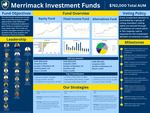
This GAME Forum poster is something that the Merrimack College Investment Funds participate in every year. We have three student managed funds, being: Alternative Investments, Equity, and Fixed Income. This poster showcases the success of the portfolio over the year 2025. IT gives some brief info on what we invest, how much, and who is involved. Overall, it is a showcase of all the hard work, dedication, and communication of the Merrimack College students involved in these funds.
-
From Stress to Strides: The Impact of Stress on Track Athletes
Jacqueline Perry
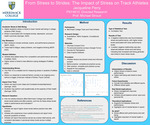
The purpose of this study is to examine how stress affects a Merrimack College track and field athlete's physical and mental performance during track practice. This research aims to examine how outside stressors affect these athletes’ stress levels and performance during track practice.
-
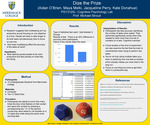
Dize the Prize
Jacqueline Perry, Aidan O'Brien, Maya Melki, and Kate Donahue
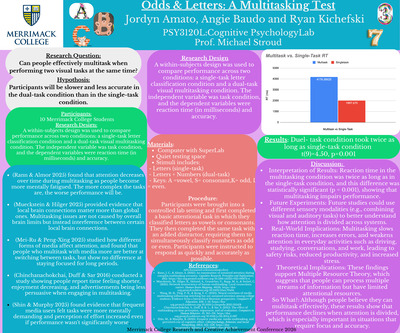
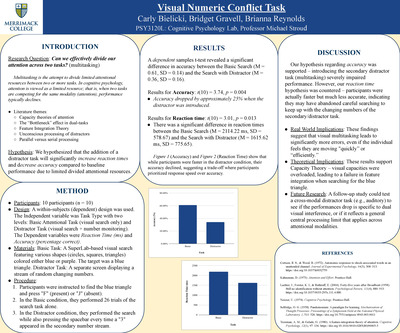
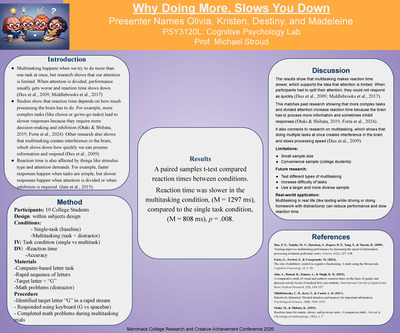
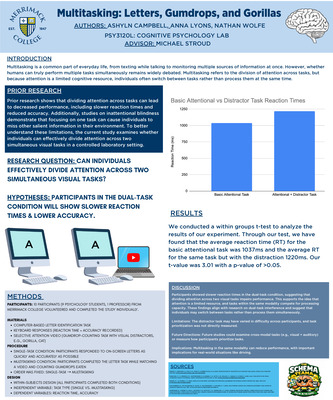
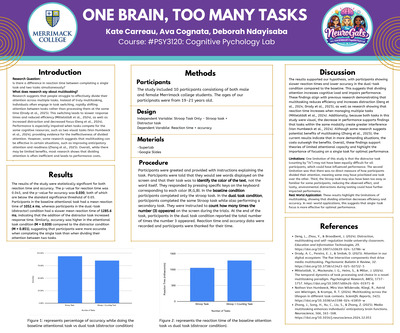
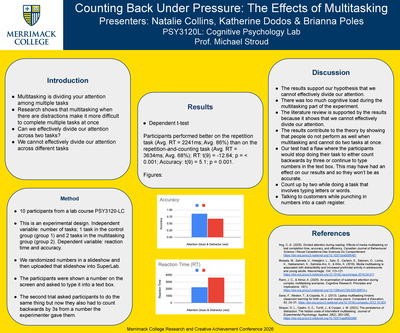
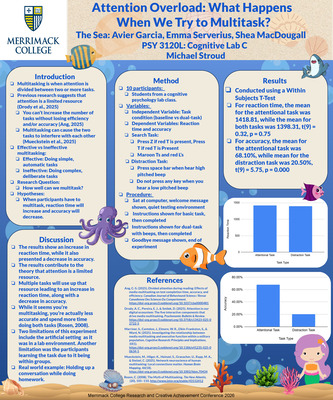
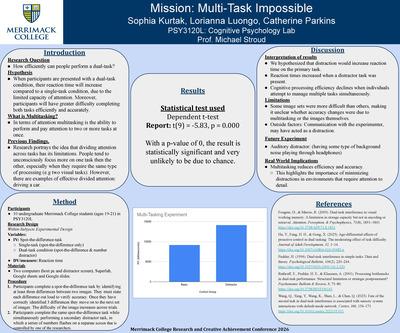
A blue circle will appear on screen a random number of times (1-9). The participant will be asked to count the number of times the blue circle appears on screen and accurately state it in the program, this is the basic attentional task. For the distractor task, They will be required to roll doubles on a set of 12 sided dice.
-
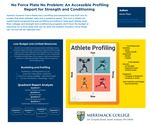
No Force Plate No Problem: An Accessible Profiling Report for Strength and Conditioning
Kevin Phan
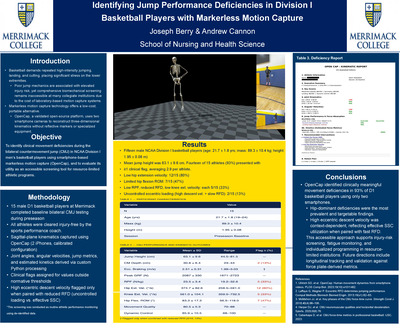
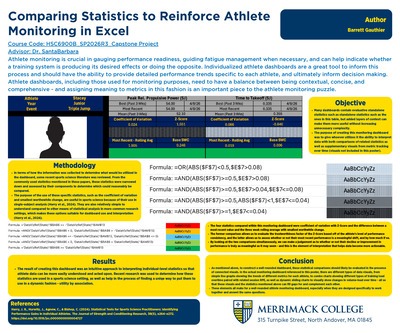
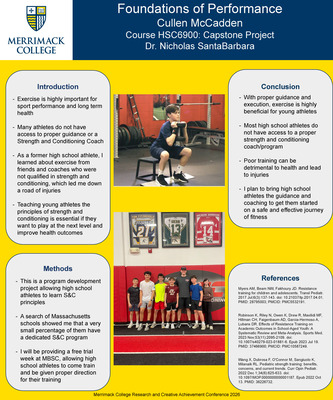
This quadrant report project is designed to provide strength and conditioning programs with a practical way to classify athletes along the force velocity spectrum without the need for expensive force plate technology. Instead of relying on lab-grade equipment, the project uses accessible field-based measures such as sprint times, jump height, reactive strength index (RSI), estimated strength levels (e.g., squat or trap bar deadlift), and basic mobility or flexibility assessments to place athletes into force-dominant (muscular) or velocity-dominant (elastic) quadrants.
The goal is to make individualized athlete profiling more accessible, especially for smaller college programs or teams with limited resources. By identifying where an athlete falls on the force–velocity curve using simple tools like jump mats, timing gates, or even mobile apps, coaches can still detect imbalances that may impact performance or increase injury risk. For example, an athlete who produces high force but lacks velocity may benefit from more plyometric or speed-focused work, while an elastic athlete may need more maximal strength development.
This approach emphasizes that high-level decision-making doesn’t require high-level technology just smart data collection and interpretation. The quadrant report becomes a cost-effective tool to guide programming, improve performance, and reduce injury risk. For a future college strength and conditioning coach, this project highlights the ability to adapt, problem-solve, and apply sport science principles in real-world settings where resources may be limited.
-
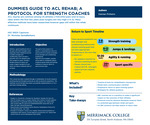
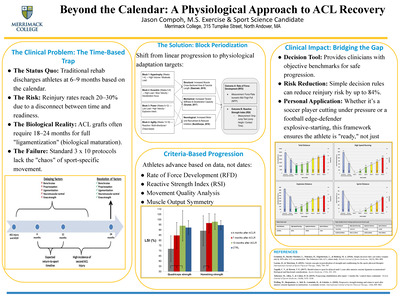
Dummies Guide To ACL Rehab: A Protocol for Strength Coaches
Damian Pinheiro
Currently there is a 20% chance of re-injury within the first 2 years after a "successful" ACL surgery. As doctors and physical therapists provide the standard of care during the initial phases of rehab, it is the strength and conditioning coach who is uniquely positioned to prepare an athlete to a safe return. This protocol will give strength and conditioning coaches the confidence they need to effectively get their athletes back into sport.
-
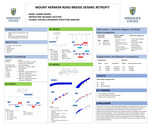
Mt Hermon Road Bridge
Usama Raheel
This project looks at the seismic retrofit of the Mt. Hermon Road Bridge using the original plans and geotechnical data. The research analyzes the bridge's geometry, supports, and foundation conditions to identify structural vulnerabilities under seismic loading. To check how well the foundation worked, we used soil data from test borings. The retrofit focuses on making the hinges better and strengthening the structure to make it more stable and flexible. In general, the project shows that combining structural and geotechnical analysis makes bridges safer in earthquakes and better at doing their jobs.
-
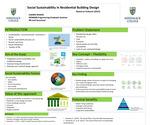
Social Sustainability in Residential Buildings Design
Usama Raheel
The goal of social sustainability in residential building design is to provide safe, welcoming, and community-focused environments that enhance people's quality of life. Many contemporary structures put cost and structural performance first, frequently ignoring crucial social aspects like social interaction, accessibility, and health and safety.
Key components of social sustainability are highlighted in this presentation, such as cheap housing, shared public areas, appropriate living circumstances, and comprehensive design. The primary conclusion is that incorporating these social factors into the design process can greatly improve both the long-term building value and the well-being of the occupants.
In general, socially conscious construction makes communities safer, healthier, and more cohesive.
-
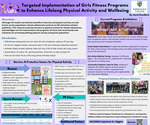
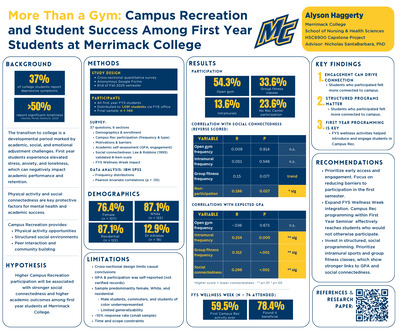
Targeted Implementation of Girls Fitness Programs to Enhance Lifelong Physical Activity and Wellbeing
Sarah Remillard
Female non-athlete adolescent girls are not reaching physical activity guidelines which puts them at risk for negative health outcomes later in life. The athlete population meets and exceeds recommendations and are highly inclined toward group sports and fitness classes where those who have been pushed away from sports or do not enjoy those activities fall far below advised guidelines. PE programs that are highly sports based may also push this group further away from exercising if they feel inadequate among the group. Physical activity has protective factors on physical, cognitive, emotional and metabolic outcomes and initiatives for life long physical activities need to be implemented for the non-sports group so they can find a physical activity they enjoy. The longer exercise and physical activity is avoided the stronger of a habit it becomes and the greater risk for health decrements down the line.
-
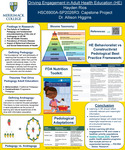
Driving Engagement in Adult Health Education
Hayden Rios
In the face of widespread morbidities and mortalities among chronic disease, the US has needed a revitalization of best practice surrounding Health Education. It is understood within primary education, the theories and practices that allow children/ adolescence learn. Through this, the science and theory of education has guided our system, and in the case of health education, has not effectively met the needs of our population. In this same vein of thought, little is understood how adults, mostly as to why (although some interdisciplinary practice in primary education carry into best practice in adult education). Pedagogy (theory and science of education) guides primary education, while Andragogy (self- guided information theory) guides most of learning opportunities in adult education. Armed with these understandings, and with the overwhelming body of data driving population health analytics, health officials have yet to make meaningful changes in peoples ability to engage in lifestyle modifications, or continued avenues of learning. With this, my capstone project seeks to build learning environments/ opportunities that meaningfully engage with the underserved sector of adults in higher educational, and professional settings.
-
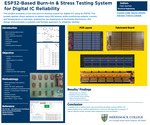
ESP32-Based Burn-In & Stress Testing System for Digital IC Reliability
Fadi Serhan
The design, implementation, and testing of an ESP32 based semiconductor burn in platform. The system applies controlled logic patterns to digital devices under test, monitors outputs behavior, measures supply current, records temperature, and streams results to a graphical user interface through MQTT. A companion universal static IC test board concept is also proposed to support truth table verification of additional logic devices. I’ll be also using a semiconductor board from the company that I work at to demonstrate the flow process.
-
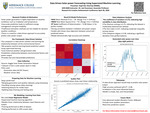
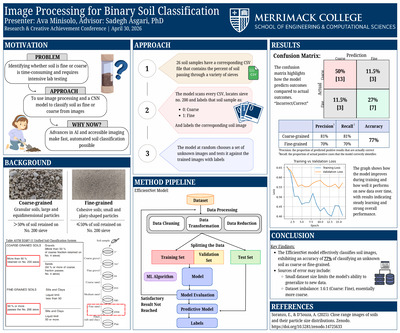
Data Driven Solar Power Forecasting Using Supervised Machine Learning
Kapil Dev Sharma
Pulse Width Modulation as an Energy-Saving Strategy for Shape Memory Alloy Based Smart Soft Composite Actuators Recent advancements in soft robotics have led to an increasing need for lightweight and energy-efficient actuators that can produce large, flexible movements. Shape Memory Alloys (SMAs), especially Nickel–Titanium (NiTi) alloys, are commonly used in smart actuation systems because they offer a high power-to-weight ratio, operate silently, and can return to their original shape when heated. When SMA wires are placed inside flexible materials like PDMS, they form Smart Soft Composite (SSC) actuators. These actuators can bend and change shape, making them useful in robotics, medical devices, and adaptable structures. Although these actuators have many benefits, they often use a lot of energy because they rely on Joule heating to function. A study by Kim et al. (2017) looked at using Pulse Width Modulation (PWM) as a better way to control these actuators to save energy without losing their performance. PWM controls the average power delivered to the actuator by changing the length of time the power is on in each signal cycle. The study tested SSC actuators made with one thick SMA wire and multiple thin bundles of SMA wires. The results showed that using PWM produced almost the same amount of force as using a traditional analog current method, but used much less energy. For SSCs with a single wire, PWM cut energy use by about 41%, and for those with multiple wires, it reduced energy by around 43%. These results show that PWM is a useful and practical way to save energy in SMA-based soft actuators. This method can greatly improve efficiency in areas like wearable robotics, mimicry systems, and low-power smart devices where small size and energy efficiency are important.
-
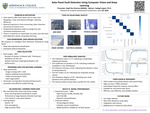
Solar Panel Fault Detection Using Computer Vision and Deep Learning
Kapil Dev Sharma
This project aims to create an automatic system for identifying faults in solar panels using machine learning and image analysis. Solar panels are used a lot for generating renewable energy, but their efficiency can decrease due to various issues like dust, bird droppings, snow, electrical problems, and physical damage. Manually checking these panels is not only slow and costly but can also be dangerous, especially in big solar farms. An intelligent fault detection system can help make maintenance more efficient and increase energy output. For this project, a publicly available dataset of solar panel images from Kaggle is used. The dataset includes images grouped into six categories: Bird-drop, Clean, Dusty, Electrical-damage, Physical-Damage, and Snow-Covered. These images show different states of solar panels and help the model learn to tell the difference between normal and faulty panels. The dataset is organized and divided into training, validation, and testing groups to make sure the model learns and is tested properly .The YOLOv8 classification model is used for this project. YOLO (You Only Look Once) is a deep learning model known for its speed and accuracy in image analysis. A pre-trained YOLO model is adapted using the solar panel dataset through transfer learning. During training, the model learns the visual features associated with each type of fault .After the model is trained, it is assessed using metrics like accuracy, precision, recall, and confusion matrix. The goal is to develop an automated system that can detect solar panel faults from images with high accuracy. This approach can help with predictive maintenance, cut down inspection costs, and boost the overall efficiency and reliability of solar energy systems.
-
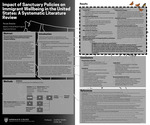
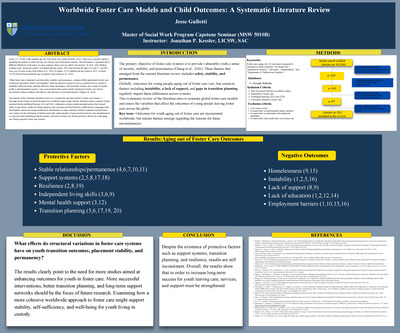
Impact of Sanctuary Policies on Immigrant Wellbeing in the United States: A Systematic Literature Review
Nicole Skaluba
This systematic literature review is focused on how sanctuary policies in the United States impact immigrant wellbeing. Although sanctuary policies do not have a legal definition, they generally involve the local or state government limiting cooperation between local law enforcement and federal immigration authorities to support newcomers (Aramayo et al., 2025; Houston et al., 2022). Municipalities can also encourage civil society to meet basic needs of immigrants through humanitarian assistance (Vitiello, 2022). These policies and practices could be implemented to foster immigrant wellbeing, health, safety, and inclusion of immigrants, (Houston et al., 2023) but the effectiveness of this goal is not well-known (Kiehne & Hafen, 2022; Houston et al., 2023). In this systematic literature review, twenty peer-reviewed articles demonstrated the themes of benefits, disadvantages, and no difference of a range of sanctuary policies on various aspects of immigrant wellbeing. Implications of this research include a need for increased publicity of sanctuary protections (Davis, 2020), a multilayered approach of preventive health, and further research on health impacts of immigrant inclusive policies (Kiehne & Hafen, 2022).
-
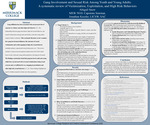
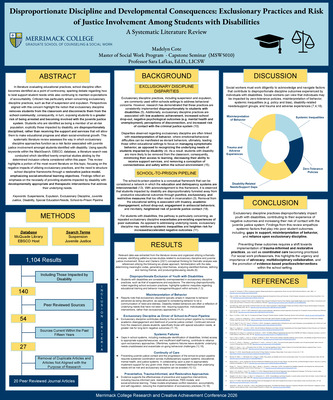
Gang Involvement and Sexual Risk Among Youth and Young Adults: A Systematic Review of Victimization, Exploitation, and High Risk Behaviors
Abigail Snow
Gang affiliation has been associated with an increased risk of exposure to violence and other high-risk behavior(Wolff et al., 2020). The relationship between gang association, high-risk sexual behavior, and sexual victimization among male and female youth and young adults requires further evaluation. This systematic review examines how gang involvement influences the outcomes of sexual victimization and engaging in risky sexual behavior such as multiple partners, unprotected sexual intercourse, ect. This systematic review includes peer-reviewed empirical studies focusing on the youth and young adult population with gang involvement. The findings consistently found that gang-involved youth and young adults have an increased risk of sexual victimization, sexual coercion, sex trafficking, illegal sexual behaviors, and risky sexual behaviors (Franchino-Olsen & Martin, 2022; Petering, 2016). These findings highlight the need for further research to best serve this population.
-
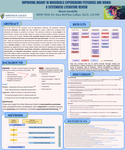
Improving Insight in Individuals Experiencing Psychosis and Mania: A Systematic Literature Review
Mario Sordello
Due to the content of their symptoms, such as hallucinations, delusions, and grandiosity, individuals experiencing psychosis and mania have been identified as having a difficult time recognizing these experiences and feelings as symptoms of an illness. This awareness is defined as having insight in the present literature. Having a lack of insight creates for a delay of receiving treatment, adhering to treatment, and an increased risk of relapse. The aim of this systematic literature review is to analyze the current literature surrounding what factors are associated with improving insight. A literature search (published 2005 - 2025) was conducted across MACKsearch that included peer-reviewed articles. The study population was individuals presenting with psychosis and mania symptoms and were assessed on their level of insight. 95 studies were screened with inclusion of a total 22 articles. Results will be synthesized using thematic analysis to provide a range of methods, interventions, and strategies that are shown to improve insight in this population. Findings can suggest possible treatment modalities and interventions clinicians can use when working with individuals experiencing psychosis and mania to help improve overall outcomes.
-
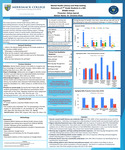
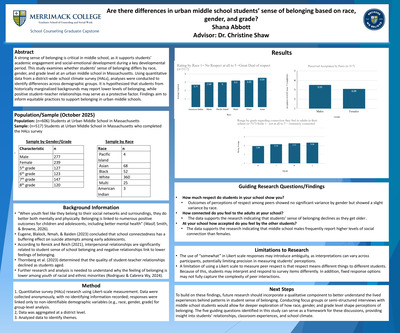
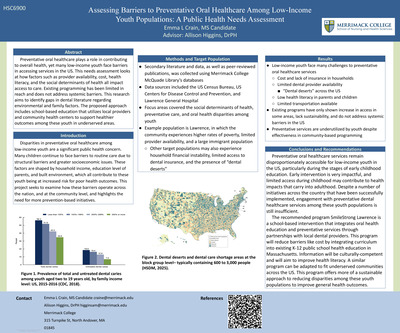
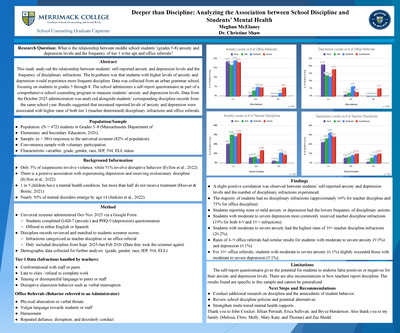
Mental Health Literacy and Help-seeking Outcomes of 7th Grade Students in a MA Middle School
Kelsey Sparuk
This study examines mental health literacy (MHL) and help-seeking behaviors among 7th grade students following the Nan Project presentation. Using MHL and help-seeking measures, the study assessed students’ knowledge of mental health concepts and their attitudes toward seeking support. Findings indicate students’ levels of mental health understanding and corresponding help-seeking tendencies. Given that suicide is a leading cause of death among adolescents (CDC, 2024), these results highlight the importance of early intervention to strengthen mental health knowledge and support-seeking behaviors.
-
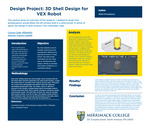
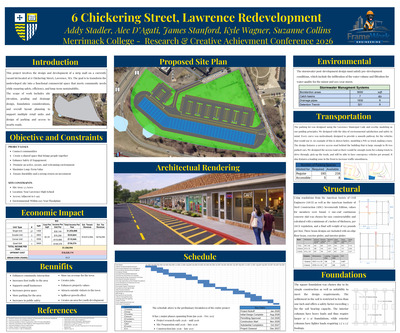
Design Project: 3D Shell Design for VEX Robot
Akhil Srivastava
Development of a 3D-printed hollow shell designed to enclose a VEX robot inspired by airfoil geometry to study aerodynamic behavior. Objective: Evaluate drag and aerodynamic efficiency in a wind tunnel. Shell mounts onto the robot to simulate a small-scale aerodynamic testing.
-
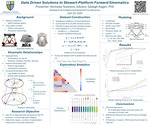
Data Driven Solutions to Stewart-Platform Forward Kinematics
Nicholas Tessitore
The Stewart Platform, or classical hexapod, is a parallel robot used in precision robotics. Positional control of these robots can be achieved from two formulations, inverse and forward kinematics. Inverse Kinematics allows you to find the actuator configuration (For a Stewart Platform this is the length of each of the 6 legs) from the end-effector pose (the x, y, and z-translations and the Euler angle orientation of the payload from the origin). This formulation provides a closed-form solution, deriving leg-length from pose directly. It is useful for robots whose sensor array can measure the translation and rotation of a point off neutral. It is not useful when the reported sensor data is the encoder ticks a motor has rotated (easily converted to the length of a leg). Forward Kinematics uses this data on the length of each leg (linear actuator) to determine the end-effector pose of the robot. This method has no closed-form solution and is typically solved using iterative methods, such as Newton-Raphson. These methods perform optimally with a close initial guess but diverge significantly with a bad initial guess or poorly conditioned Jacobian matrix. Machine-Learning supported Forward Kinematics aims to improve robustness, stability, and consistency when those assumptions are violated without replacing the underlying physical model. This work compares the accuracy and computation times of several multilayer perceptrons (MLPs) varying in size. The goal is quick, accurate (<0.2mm of translation in x, y, or z) solutions within the robots geometrically feasible workspace.
-
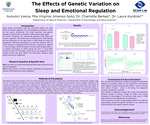
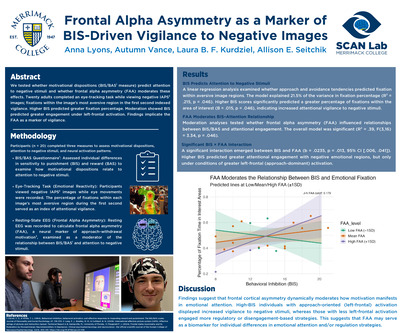
The Effects of Genetic Variation on Sleep and Emotional Regulation
Autumn Vance and Mia Virginia Jimenez-Soto
Sleep quality, particularly rapid eye movement (REM) sleep, has been linked to emotion regulation, yet the biological mechanisms underlying these links remain poorly understood. This project examines how genetic variation in the serotonin transporter-linked polymorphic region (5-HTTLPR) influences the relationship between REM sleep and emotion regulation in adolescents and young adults. By utilizing EEG headbands to record sleep physiology we are able to collect information on REM duration, REM latency, and the proportion of the night spent in REM sleep. Genetic analysis on buccal swab samples allows us to classify participants as either having short or long allelic variants for the 5-HTTLPR gene. Along with a task that requires participants to either maintain or reappraise their emotions in response to negative or neutral photos, these factors are analysed to test if variation in the 5-HTTLPR gene moderates the association between sleep quality and emotion regulation.
-
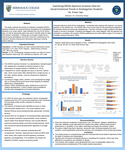
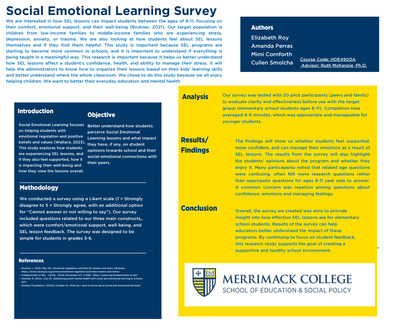
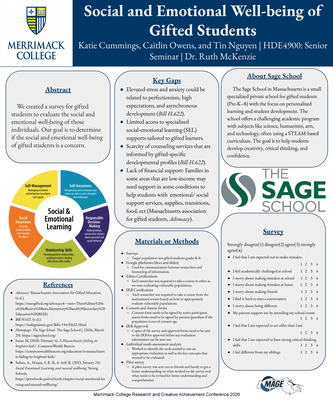
Examining DESSA-Aperture Screener Data for Social-Emotional Trends in Kindergarten Students
Evelyn Vigo
This study explores the results of a teacher-completed DESSA- Aperture Screener for social emotional competency for kindergarten students in an urban district. Data collected from the 24-25 school year, as well as sequential years was used to identify areas of need, and trends in evaluation. Findings aim to provide a base line for examining the strengthens and limits of the SEL screening tool for long-term decision-making and intervention planning in diverse school settings.
-
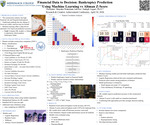
Financial Data to Decision: Bankruptcy Prediction Using Machine Learning vs Altman Z-Score
Brayden Waterman
Financial distress and bankruptcy in construction firms can have significant economic consequences, making early detection of financial risk an important research problem. This project investigates whether financial ratios can be used to predict corporate bankruptcy up to two years in advance. The study focuses on publicly traded construction companies and analyzes financial statement data collected from SEC filings. Key financial variables include revenue, earnings before interest and taxes (EBIT), net income, total assets, total liabilities, current assets, current liabilities, inventory, shareholder equity, and debt obligations.
Using these variables, several financial ratios are calculated to evaluate company performance and financial stability, such as working capital to total assets, EBIT to total assets, net income to total assets, and debt to total assets. These ratios are then used to compute a bankruptcy prediction metric based on the Altman Z-Score framework. The dataset includes both companies that later filed for bankruptcy and companies that remained operational, allowing for comparison between financially distressed and healthy firms.
The objective of the project is to build a predictive model that can identify financial warning signs prior to bankruptcy. By analyzing patterns in the financial ratios and comparing Z-Scores across firms, the research evaluates whether the model can successfully classify companies into distress or non-distress categories. The results contribute to understanding how financial indicators can support early risk detection in the construction industry.
-
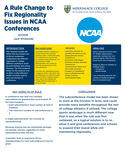
A Rule Change to Fix Regionality Issues in NCAA Conferences
Jack Whiteside
A proposal to allow a new unique conference structure in the NCAA that effectively allows a conference to split into two "sub-conferences" under one administrative umbrella (different from divisions). With this being an option for conferences, it would allow for larger conferences with a widespread geography to increase regionality in it, while also maintaining revenue and competitive opportunities for the member schools.
-
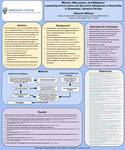
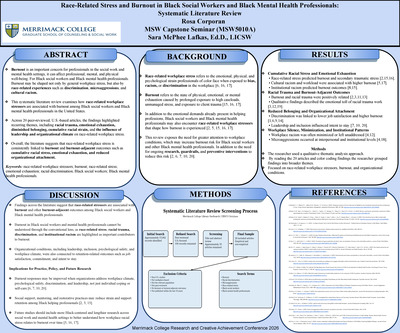
Mission, Misconduct, and Mitigation: Leadership-Driven Harm and Structural Safeguards in Nonprofits: A Systematic Literature Review
Deborah Wilfond
Work environments perceived as psychologically unsafe as a result of leadership behaviors are correlated with increased social-emotional and occupational problems amongst staff. These dynamics are particularly damaging in nonprofits which frequently rely on trust, moral authority, and shared values.
This systematic literature review examines how leadership behaviors perceived as psychologically unsafe affect outcomes for organizational members in nonprofits, as well as what structural safeguards may moderate these effects.
A review of the final identified studies published within the last five years reveals three thematic domains:
(1) types of interpersonal leader behaviors which cause harm;
(2) forms of resultant psychological, social, or occupational (but not physical) harm to organizational members; and
(3) practices that organizations can use to prevent against or mitigate such harm.
-
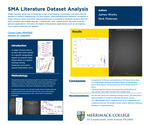
SMAD, the Shape Memory Alloy Database
James Works and Nick Petersen
Shape memory alloys are materials, typically metal alloys, that can recall an original shape after being subjected to a thermal load or temperature condition. Taking a wire as an example, one could bend this wire or twist it up, then heat the wire to have it straighten back out to its original shape. Shape memory alloys, or SMA's, are popular in high-end fields like soft robotics and biomedical engineering, so their properties must be rigorously calculated as new materials of this type are discovered. Our project idea is to compose an online database for these alloys, where businesses and engineers could search for which alloys would be best for their specific applications based on material properties and data validation (experimental vs machine learning, etc.).
-
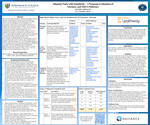
Aligning Tools with Standards – A Program Evaluation of Naviance and MEFA Pathways
Danielle Zajchowski
This research-based program evaluation is designed with the intent to understand how Naviance and MEFA Pathways compare in their alignment to the Massachusetts College, Career, and Civic Readiness (CCCR) Standards. The Department of Elementary and Secondary Education has designed MyCAP Frameworks for college, career, and civic readiness for students in grades 9-12 with a focus on three key domains: personal/social development, career development education, and academic, college, & career planning. The purpose of analyzing to what degree these post-secondary planning platforms align with state standards is to provide insight to schools as high school counselors assist students in planning their futures. Each post-secondary planning platform’s standard alignment was measured through a scale, as well as using evidence-based artifacts, which then produced a score of standard alignment for each grade level in each respective platform, in addition to an overall total score of alignment for each platform. Ultimately, research showed that MEFA Pathways is more aligned with the Massachusetts College, Career, and Civic Readiness (CCCR) Standards than Naviance is.
Printing is not supported at the primary Gallery Thumbnail page. Please first navigate to a specific Image before printing.