

Files
Download Full Text (665 KB)
Description
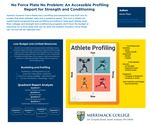
This quadrant report project is designed to provide strength and conditioning programs with a practical way to classify athletes along the force velocity spectrum without the need for expensive force plate technology. Instead of relying on lab-grade equipment, the project uses accessible field-based measures such as sprint times, jump height, reactive strength index (RSI), estimated strength levels (e.g., squat or trap bar deadlift), and basic mobility or flexibility assessments to place athletes into force-dominant (muscular) or velocity-dominant (elastic) quadrants.
The goal is to make individualized athlete profiling more accessible, especially for smaller college programs or teams with limited resources. By identifying where an athlete falls on the force–velocity curve using simple tools like jump mats, timing gates, or even mobile apps, coaches can still detect imbalances that may impact performance or increase injury risk. For example, an athlete who produces high force but lacks velocity may benefit from more plyometric or speed-focused work, while an elastic athlete may need more maximal strength development.
This approach emphasizes that high-level decision-making doesn’t require high-level technology just smart data collection and interpretation. The quadrant report becomes a cost-effective tool to guide programming, improve performance, and reduce injury risk. For a future college strength and conditioning coach, this project highlights the ability to adapt, problem-solve, and apply sport science principles in real-world settings where resources may be limited.
Publication Date
4-30-2026
Keywords
Profiling/Bucketing, Accessible, Quadrant Report
Recommended Citation
Phan, Kevin, "No Force Plate No Problem: An Accessible Profiling Report for Strength and Conditioning" (2026). RCAC 2026 Posters. 16.
https://scholarworks.merrimack.edu/rcac_2026_posters/16