

Files
Download Full Text (917 KB)
Description
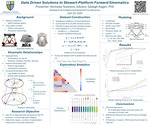
The Stewart Platform, or classical hexapod, is a parallel robot used in precision robotics. Positional control of these robots can be achieved from two formulations, inverse and forward kinematics. Inverse Kinematics allows you to find the actuator configuration (For a Stewart Platform this is the length of each of the 6 legs) from the end-effector pose (the x, y, and z-translations and the Euler angle orientation of the payload from the origin). This formulation provides a closed-form solution, deriving leg-length from pose directly. It is useful for robots whose sensor array can measure the translation and rotation of a point off neutral. It is not useful when the reported sensor data is the encoder ticks a motor has rotated (easily converted to the length of a leg). Forward Kinematics uses this data on the length of each leg (linear actuator) to determine the end-effector pose of the robot. This method has no closed-form solution and is typically solved using iterative methods, such as Newton-Raphson. These methods perform optimally with a close initial guess but diverge significantly with a bad initial guess or poorly conditioned Jacobian matrix. Machine-Learning supported Forward Kinematics aims to improve robustness, stability, and consistency when those assumptions are violated without replacing the underlying physical model. This work compares the accuracy and computation times of several multilayer perceptrons (MLPs) varying in size. The goal is quick, accurate (<0.2mm of translation in x, y, or z) solutions within the robots geometrically feasible workspace.
Publication Date
4-30-2026
Keywords
machine learning, forward kinematics, Stewart platforms
Recommended Citation
Tessitore, Nicholas, "Data Driven Solutions to Stewart-Platform Forward Kinematics" (2026). RCAC 2026 Posters. 87.
https://scholarworks.merrimack.edu/rcac_2026_posters/87