

Files
Download Full Text (2.0 MB)
Description
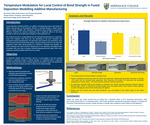
Interlaminar bond strength in polymer structures produced by fused deposition modelling (FDM) is controlled by bond diffusion between deposited layers. Therefore, it is expected that the interlaminar bond strength can be manipulated by controlling the thermal history of the deposited layers. To test this hypothesis, polylactic acid tensile test coupons were fabricated using a commercially available FDM printer. During the build process the central section of the specimens was subjected to either pre-cooling (cooling of the layer ahead of the extruder) or post-cooling (cooling of the deposited layer behind the extruder). The effects of build orientation were also investigated by building specimens with the predominant layer alignment being aligned with (axial) and perpendicular to (transverse) the loading axis of the specimen. Tensile test results show that pre-cooling provides a more significant reduction in strength than post-cooling when compared with the control group with no cooling. Additionally, precooling resulted in a greater reduction in strength for the axial specimens (46%) compared to the reduction in strength for the transverse specimens (18%).
Publication Date
4-30-2026
Keywords
Additive Manufacturing, Experiments, Tensile Strength
Recommended Citation
Hoffer, Emma; Husson, Emily; and Shoemaker, Thomas, "Temperature Modulation for Local Control of Bond Strength in Fused Deposition Modelling Additive Manufacturing" (2026). RCAC 2026 Posters. 92.
https://scholarworks.merrimack.edu/rcac_2026_posters/92