

Files
Download
Download Full Text (6.9 MB)
Publication Date
4-30-2026
Recommended Citation
Hatfield, Lindsey; Gadbois, Margaret; Trowt, Jordyn; Ayanian, Daniel; and Collier, Raynna, "Survey of Bird Diversity and Feeding Behavior on the Merrimack College Campus: A Pilot Study" (2026). RCAC 2026 Posters. 123.
https://scholarworks.merrimack.edu/rcac_2026_posters/123
Comments
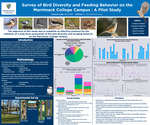
The specific aim of this study was to establish an effective protocol for the initiation of a long-term assessment of the bird diversity and foraging behavior on the Merrimack College campus. The experimental pilot phase of data collection was conducted during the transitional period from February to April, 2026. The goal was to document and quantify bird species diversity and foraging behavior at a heavily trafficked feeding site on campus, using multiple feeders all consolidated to a specific location. Feeders contained a variety of foods, including peanuts, butterballs, sunflower, mixed seeds, safflower, and thistle. The primary objective was to identify the most preferred seed types based on the frequency and duration of feeding visits, while also examining how abiotic factors influence bird activity. Observations were conducted daily on a predictable schedule to control for diurnal variation in visitation times of different species. As seasonal conditions shift and temperatures increase, a greater diversity and frequency of birds visitations to the feeders was expected. To improve accuracy during these high activity periods, observations are conducted in pairs to minimize the risk of misidentifying species. Species identification, visit frequency, and the length of visitation time were documented. Environmental data were also gathered during each observation period, including actual and apparent temperature, wind speed, precipitation, and atmospheric pressure. These data points are then analyzed to identify potential correlations between weather conditions, species diversity, and feeding behavior. This observational experiment serves as baseline data for the establishment of a longer-term study. The results we have will be used in the future to determine trends in bird diversity, foraging behaviors and food preferences over time. The procedure can be further adjusted to continue to find trends in the long run of this study and ask more questions to be further researched.