

Files
Download Full Text (508 KB)
Description
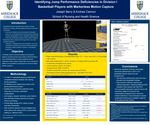
This screening used OpenCap, a smartphone-based markerless motion capture system, to screen bilateral countermovement jump (CMJ) performance in 15 NCAA Division I men's basketball players during preseason baseline testing. Joint kinematics, angular velocities, jump performance metrics, and estimated force metrics were derived from OpenCap pose estimation data using custom Python processing. Clinical flags were assigned when values fell outside normative thresholds.
Results revealed that 93% of athletes (14/15) presented with at least one clinical deficiency, averaging 2.9 flags per athlete. Low hip extension velocity was the most prevalent finding at 80%, followed by limited hip flexion range of motion (47%). Low relative propulsive force, reduced rate of force development, and low knee extension velocity were each present in 33% of athletes. Notably, high eccentric descent velocity was only flagged as a deficiency when paired with reduced rate of force development (13%), distinguishing uncontrolled eccentric loading from effective stretch-shortening cycle utilization. Mean jump height was 63.1 ± 9.6 cm across the cohort.
The high prevalence of hip-dominant deficiencies across the roster highlights the importance of targeted interventions for hip mobility and extensor power development in basketball populations. These findings demonstrate that clinically meaningful movement screening can be conducted using accessible, low-cost markerless technology, offering a practical alternative for institutions that lack the resources for laboratory-based motion capture systems. This approach supports proactive injury risk identification, fatigue monitoring, and individualized training program design in collegiate athletics.
Publication Date
4-30-2026
Keywords
Markerless Motion Capture, Countermovement Jump, Movement Screening
Recommended Citation
Berry, Joseph, "Identifying Jump Performance Deficiencies in Division I Basketball Players with Markerless Motion Capture" (2026). RCAC 2026 Posters. 13.
https://scholarworks.merrimack.edu/rcac_2026_posters/13