

Files
Download Full Text (1.1 MB)
Description
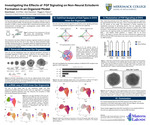
During embryogenesis, placodal-derived sensory organs originate from the non-neural ectoderm (NNE). The decision of definitive ectoderm (DE) to transition to NNE or neural ectoderm (NE) is determined by exposure to the developmental morphogen bone morphogenetic protein (BMP), which emanates from the neural plate. This interaction has been utilized to develop organoid models for placodal-derived tissues like the inner ear in vitro. Here, we utilize published single-cell RNA-sequencing data to investigate additional signaling pathways that may influence DE to NNE formation in 3 days in vitro (DIV) mouse stem cell-derived inner ear organoids. Using the CellChat algorithm, we identified fibroblast growth factor (FGF) signaling as a potential candidate for improving NNE formation. During development, FGF signaling induces the transition of NNE to pre-placodal ectoderm. Additionally, established protocols for generating human inner ear organoids utilize combined BMP and low-level FGF exposure to induce DE to NNE formation. To test whether low-level FGF can improve NNE formation in our mouse inner ear organoid model, we treated DIV3 organoids with 10ng/mL BMP +/- 4ng/mL FGF for 24 hours. RNA was then collected from organoids and performed qPCR for NE and NNE marker genes to assess the efficiency of NE vs. NNE formation. Our results showed that low-level FGF exposure had no effect on expression of the NNE marker genes Gata3, Nes and Tfap2a, and variably increased the expression of the NE gene Pou3f1. These results suggest that early FGF modulation is not needed in the inner ear organoid protocol to induce NNE formation.
Publication Date
4-30-2026
Keywords
Inner-ear, Organoid, Growth Factors
Recommended Citation
Evans, Kiara, "Investigating the Effects of FGF Signaling on Non-Neural Ectoderm Formation in an Organoid Model" (2026). RCAC 2026 Posters. 72.
https://scholarworks.merrimack.edu/rcac_2026_posters/72