Files
Download Full Text (5.2 MB)
Description
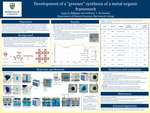
Metal-organic frameworks (MOFs) are the focus of an increasingly growing area of research. MOFs consist of a metal ion or secondary building unit (SBU) and ligands that form porous materials. The volume and shape of the pores can be varied by changing the size and structure of the ligands, allowing for a variety of applications ranging from water purification to drug delivery. Our research investigates a greener synthesis of HKUST-1, a MOF comprised of a dicopper(II) SBU and benzene-1,3,5-tricarboxylate linkers. A commonly used synthesis of HKUST-1 requires high temperatures, high pressures, and toxic solvents such as dimethylformamide (DMF). Previous research has found that this synthesis can be promoted by ultrasonication, which significantly decreases the amount of energy required. We have further lowered the environmental and health impacts of this synthetic method by substituting ?-valerolactone (GVL), a solvent derived from biomass, for DMF. We are examining the impact of this “greener” synthetic method on the properties of the MOF, including its pore size and surface area which are related to its ability to absorb water from the atmosphere and adsorb dyes from aqueous solutions. Our experimental results from our attempts to optimize this synthetic method will be presented.
Publication Date
4-30-2026
Keywords
Inorganic chemistry, green chemistry
Recommended Citation
DiBlasio, Grace, "Development of a “Greener” Synthesis of a Metal-Organic Framework" (2026). RCAC 2026 Posters. 67.
https://scholarworks.merrimack.edu/rcac_2026_posters/67