

Files
Download Full Text (271 KB)
Description
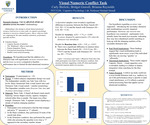
This study investigates whether individuals can effectively divide their attention across two tasks, given that attention is a limited cognitive resource. Participants completed a basic visual search task in which they identified the presence or absence of a target stimulus (a blue triangle) among distractors. Performance was measured using reaction time and accuracy. In the experimental condition, participants completed the same visual search task while simultaneously performing a distractor task within the same visual modality. The distractor task required participants to monitor a continuous stream of numbers and press the spacebar whenever the number 3 appeared. By comparing performance between the single-task (baseline) condition and the dual-task (visual search + distractor) condition, this study aims to determine how dividing attention affects cognitive performance. It is predicted that participants will show slower reaction times and reduced accuracy in the dual-task condition due to competition for limited attentional resources. This design allows for a controlled examination of multitasking and the extent to which attention can be shared between tasks that rely on the same sensory modality. The findings will contribute to a better understanding of the limits of attention and the cognitive costs associated with multitasking in everyday situations.
Publication Date
4-30-2026
Keywords
Shape, color, number
Recommended Citation
Bielicki, Carly; Gravell, Bridget; and Reynolds, Brianna, "Visual Numeric Conflict Task" (2026). RCAC 2026 Posters. 117.
https://scholarworks.merrimack.edu/rcac_2026_posters/117